BRABUS BODO - limited to 77 units
0-100 0
Torque 0
Power 0
VMax 0
DRIVEN BY LEGACY
What happens when you follow your dream, your passion, your ambition—and you absolutely refuse to let anybody or anything get in your way? This story begins with a person. With one man who saw possibility where others saw limits. That man was Bodo Buschmann. Not a man of half measures, but a life of bold decisions. In 1977, in Bottrop, the heart of Germany’s Ruhr region, his vision turned into an idea. That idea turned into a lifelong passion, and that passion is what built BRABUS.
Bodo was its voice, its soul, its driving force. Decades worth of cars, innovations that pushed boundaries, and for 42 years, he and his team kept pushing. Bodo didn't just build cars. He built a legacy on the belief that extraordinary was the only standard worth having. To him, a car was never just the means. It was the end. It was identity. He defined our future, he followed his passion, he made us who we are. And in the end, his legacy became our mission.
Yet one thing remained unfinished.
One concept. One car.
Bodo was its voice, its soul, its driving force. Decades worth of cars, innovations that pushed boundaries, and for 42 years, he and his team kept pushing. Bodo didn't just build cars. He built a legacy on the belief that extraordinary was the only standard worth having. To him, a car was never just the means. It was the end. It was identity. He defined our future, he followed his passion, he made us who we are. And in the end, his legacy became our mission.
Yet one thing remained unfinished.
One concept. One car.
1 / 6
DESIGN & EXTERIOR. BORN FROM PASSION.
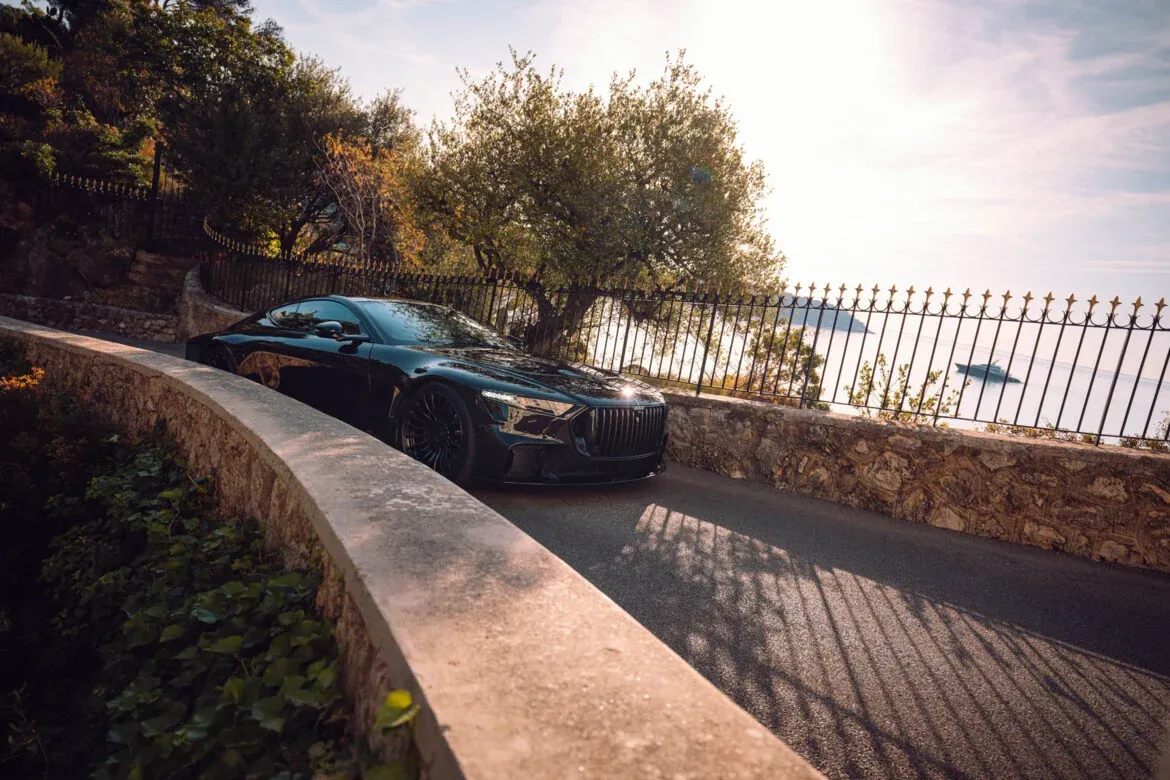
“I want to build a large coupe,” we would hear Bodo say time and again. “A Gran Turismo. Attitude-forward, high-class, unapologetic. I want it to be inspired by the golden age of the automobile, yet translated into modern day. Progressive, bold, effortless in its presence, powerful and undeniably BRABUS.” Now, we are honoring his name by finally bringing his vision to life. And, of course, it could only carry one name: BODO. Production is limited to 77 units worldwide, with annual production volumes ranging between 10 and 15 vehicles.
With the support of state-of-the-art Computer-Aided Design (CAD) technology, numerous iterations were developed until the BRABUS engineers, designers and production experts arrived at the perfect synthesis of striking aesthetics and uncompromising power. Slated for a top speed of 360 km/h (223 mph) since the first sketch of the BRABUS BODO was put to paper, aerodynamic efficiency also played a defining role throughout the entire engineering process, with strong vertical load and precise balance between the front and rear axles forming key pillars of the vehicle’s development.
To achieve this, the entire body—apart from the windows and fixed panoramic glass roof—was constructed from high-strength carbon fiber. Within BRABUS’ advanced composite manufacturing facilities, each individual component was formed using molds and then cured under controlled heat and pressure inside an autoclave. Particular emphasis was placed on perfect fitment, exemplary panel gaps and flawlessly smooth surface finishes.
The distinctive face of the BRABUS BODO is defined by unique LED matrix headlights and its striking radiator grille featuring the BRABUS emblem and a total of 13 vertical slats. Integrated within are also two large RAM-AIR ducts, which supply the precision-engineered twelve-cylinder engine with cool intake air. Equally characteristic are the aerodynamically optimized air intakes in the front fascia, which ensure a constant supply of fresh air to the radiators for water and oil, as well as to the front brakes. The high-gloss sealed exposed-carbon front spoiler generates aerodynamic downforce at high speeds on the front axle while further emphasizing the vehicle’s sporty appearance.
In the side view, alongside the BRABUS wheels, the strikingly low, flowing silhouette of the BRABUS BODO immediately captures attention. Standing just 130 centimeters (4.2 ft.) tall, the supercar features elegantly sculpted rear side sections that taper dynamically toward the back and transition seamlessly into the tail end.
The rear view is defined not only by its wide proportions but also by an innovative lighting architecture. The diffuser integrated beneath, made from the same high-tech composite material, contributes not only to the rear axle’s downforce concept but also visually highlights the exhaust system. Positioned on either side of the diffuser channel are two rectangular tailpipes per side, stacked vertically. These are manufactured from titanium using a high-tech 3D metal printing process and form part of the BRABUS high-performance exhaust system, creating a distinctive and powerful visual signature.
Even greater downforce at the rear of the Gran Turismo coupe is generated by the electrically deployable two-stage rear spoiler. At higher speeds, it automatically extends in multiple stages and continuously adapts its position to increasing aerodynamic demands in order to enhance rear-axle stability and balance. Under heavy braking above 140 km/h (87 mph), the system reacts instantly by positioning the spoiler vertically as an air brake, using the resulting increase in aerodynamic drag to support more effective deceleration. Aerodynamic refinement also characterizes the exposed-carbon trunk lid: a centrally positioned high-speed fin further improves straight-line stability at high speeds. The “77” logo positioned under the rear window commemorates the year 1977, when Bodo Buschmann founded BRABUS almost half a century ago.
With the support of state-of-the-art Computer-Aided Design (CAD) technology, numerous iterations were developed until the BRABUS engineers, designers and production experts arrived at the perfect synthesis of striking aesthetics and uncompromising power. Slated for a top speed of 360 km/h (223 mph) since the first sketch of the BRABUS BODO was put to paper, aerodynamic efficiency also played a defining role throughout the entire engineering process, with strong vertical load and precise balance between the front and rear axles forming key pillars of the vehicle’s development.
To achieve this, the entire body—apart from the windows and fixed panoramic glass roof—was constructed from high-strength carbon fiber. Within BRABUS’ advanced composite manufacturing facilities, each individual component was formed using molds and then cured under controlled heat and pressure inside an autoclave. Particular emphasis was placed on perfect fitment, exemplary panel gaps and flawlessly smooth surface finishes.
The distinctive face of the BRABUS BODO is defined by unique LED matrix headlights and its striking radiator grille featuring the BRABUS emblem and a total of 13 vertical slats. Integrated within are also two large RAM-AIR ducts, which supply the precision-engineered twelve-cylinder engine with cool intake air. Equally characteristic are the aerodynamically optimized air intakes in the front fascia, which ensure a constant supply of fresh air to the radiators for water and oil, as well as to the front brakes. The high-gloss sealed exposed-carbon front spoiler generates aerodynamic downforce at high speeds on the front axle while further emphasizing the vehicle’s sporty appearance.
In the side view, alongside the BRABUS wheels, the strikingly low, flowing silhouette of the BRABUS BODO immediately captures attention. Standing just 130 centimeters (4.2 ft.) tall, the supercar features elegantly sculpted rear side sections that taper dynamically toward the back and transition seamlessly into the tail end.
The rear view is defined not only by its wide proportions but also by an innovative lighting architecture. The diffuser integrated beneath, made from the same high-tech composite material, contributes not only to the rear axle’s downforce concept but also visually highlights the exhaust system. Positioned on either side of the diffuser channel are two rectangular tailpipes per side, stacked vertically. These are manufactured from titanium using a high-tech 3D metal printing process and form part of the BRABUS high-performance exhaust system, creating a distinctive and powerful visual signature.
Even greater downforce at the rear of the Gran Turismo coupe is generated by the electrically deployable two-stage rear spoiler. At higher speeds, it automatically extends in multiple stages and continuously adapts its position to increasing aerodynamic demands in order to enhance rear-axle stability and balance. Under heavy braking above 140 km/h (87 mph), the system reacts instantly by positioning the spoiler vertically as an air brake, using the resulting increase in aerodynamic drag to support more effective deceleration. Aerodynamic refinement also characterizes the exposed-carbon trunk lid: a centrally positioned high-speed fin further improves straight-line stability at high speeds. The “77” logo positioned under the rear window commemorates the year 1977, when Bodo Buschmann founded BRABUS almost half a century ago.
POWER & SOUND. GRAN TURISMO.
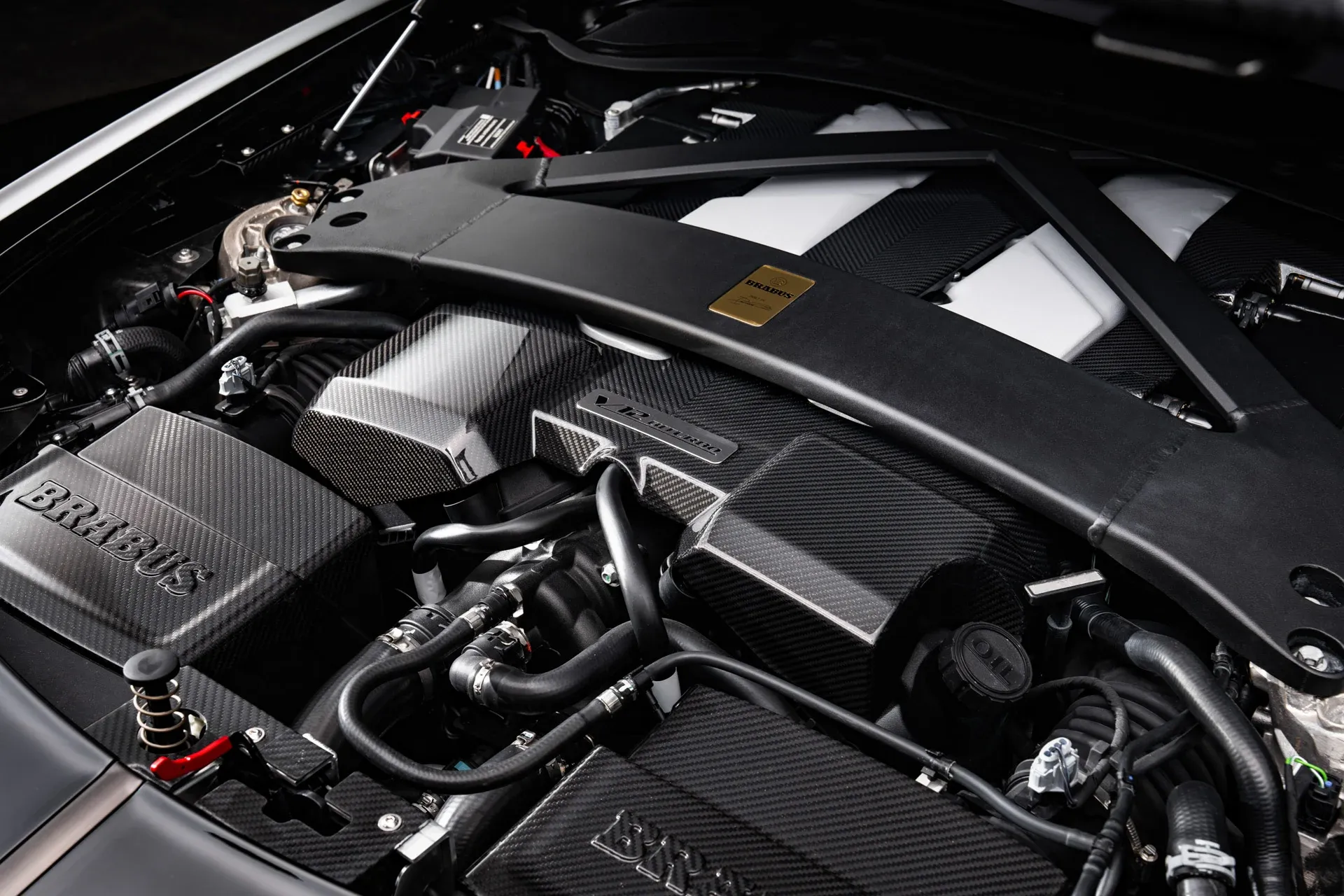
The BRABUS BODO is equipped with a hand-built 5.2-liter V12 biturbo engine, featuring two flow-optimized four-valve cylinder heads and a fuel injection system engineered according to the latest technological standards. Complementing this is the BRABUS high-performance turbo system, consisting of a RAM-AIR airbox, highly efficient intercooling and two specially developed turbochargers.
This sophisticated powerplant produces a peak performance output of 735 kW / 1,000 hp at 6,400 rpm as well as a maximum torque of 1,200 Nm (885 lb-ft), which is available consistently between 2,900 and 5,000 rpm. Power is transmitted to the rear wheels via an eight-speed automatic transmission with a torque converter, which can also be operated manually using the carbon-fiber BRABUS paddle shifters at the steering wheel. The electronic differential regulates traction differences between the two driven wheels instantly, with up to 100 percent locking capability. The entire drivetrain is lubricated using high-performance fluids from technology partner MOTUL.
From a standstill, the 2+2-seater accelerates to 100 km/h (62 mph) in just 3.0 seconds. After 8.5 seconds, the Gran Turismo coupe reaches 200 km/h (124 mph). The sprint from 0 to 300 km/h (186 mph) is completed in just 23.9 seconds. Even at this point, the vehicle’s potential is far from exhausted: only at 360 km/h (223 mph) does an electronic limiter bring further acceleration to a halt.
This sophisticated powerplant produces a peak performance output of 735 kW / 1,000 hp at 6,400 rpm as well as a maximum torque of 1,200 Nm (885 lb-ft), which is available consistently between 2,900 and 5,000 rpm. Power is transmitted to the rear wheels via an eight-speed automatic transmission with a torque converter, which can also be operated manually using the carbon-fiber BRABUS paddle shifters at the steering wheel. The electronic differential regulates traction differences between the two driven wheels instantly, with up to 100 percent locking capability. The entire drivetrain is lubricated using high-performance fluids from technology partner MOTUL.
From a standstill, the 2+2-seater accelerates to 100 km/h (62 mph) in just 3.0 seconds. After 8.5 seconds, the Gran Turismo coupe reaches 200 km/h (124 mph). The sprint from 0 to 300 km/h (186 mph) is completed in just 23.9 seconds. Even at this point, the vehicle’s potential is far from exhausted: only at 360 km/h (223 mph) does an electronic limiter bring further acceleration to a halt.
WHEELS & CHASSIS. EFFORTLESS.
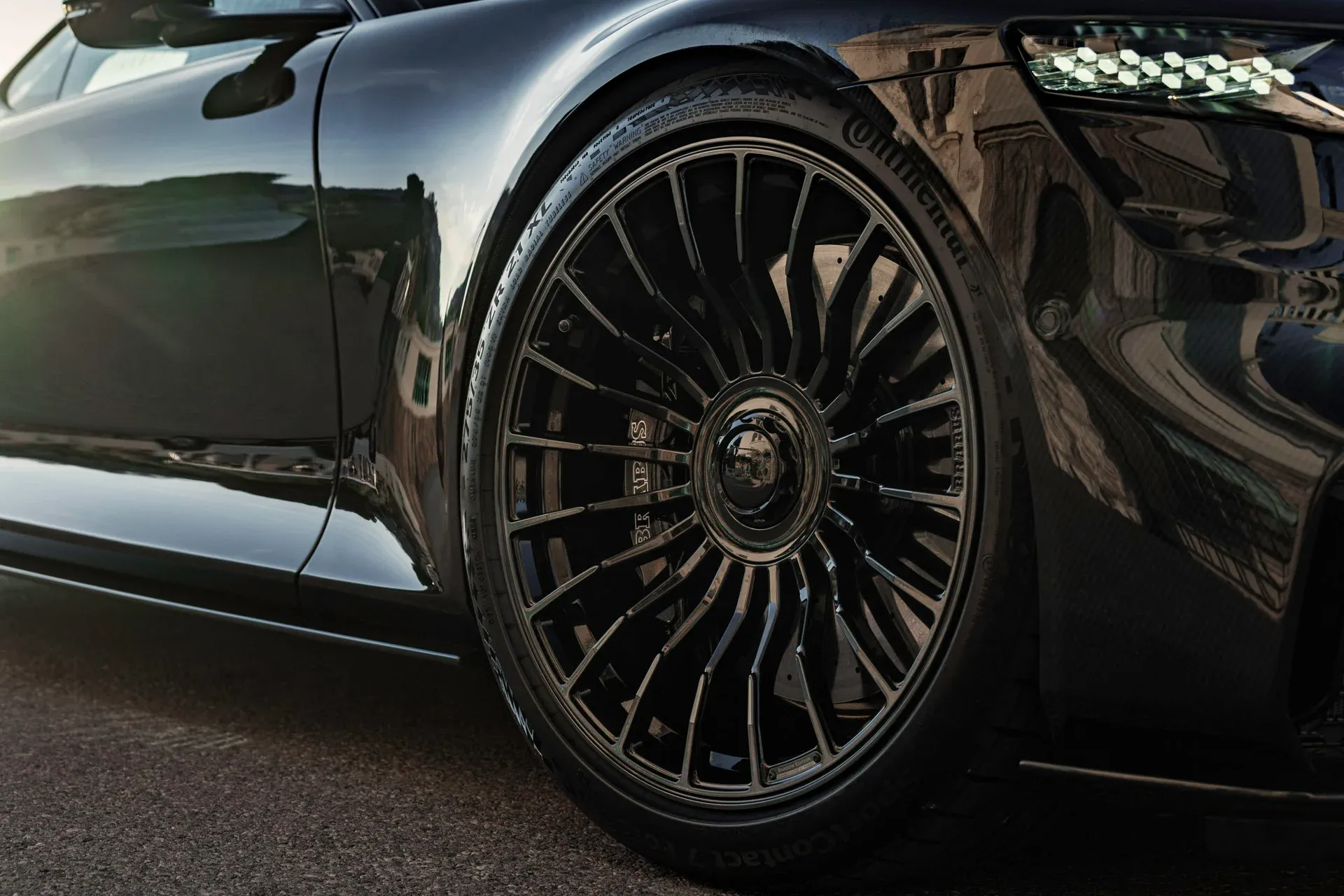
Complementing its low, wide stance, the 2+2-seater rolls on concave 21-inch BRABUS Monoblock Z-GT “Shadow Edition” forged wheels in size 9.5Jx21, fitted with 275/35 ZR 21 Continental SportContact 7 Force high-performance tires, developed exclusively for the BRABUS BODO. At the rear axle, 325/30 ZR 21 tires mounted on eleven-and-a-half-inch-wide wheels ensure optimal traction for the driven rear wheels as well as outstanding lateral stability during fast cornering. Manufactured using the latest forging technology and CNC machining, they feature 20 intricate, concavely shaped spokes, along with a center-lock-style hub cover. They not only offer exceptional strength but are also remarkably lightweight for their large dimensions. This reduces unsprung mass, resulting in more agile handling. A brand-typical black finish completes the look.
The suspension architecture of the BRABUS BODO combines a double wishbone front setup with a highly sophisticated multi-link rear axle. From the cockpit, the driver can select from five different driving modes, ranging from a comfort-oriented setup for everyday road use to a distinctly firm configuration designed for maximum performance on the racetrack. Furthermore, the BRABUS BODO is equipped with a lift system for both the front and rear axles, allowing the entire vehicle to be raised by approximately 25 millimeters (0.9 in.). Once a speed of 45 km/h (28 mph) is reached, the suspension automatically returns to its normal ride height.
The suspension architecture of the BRABUS BODO combines a double wishbone front setup with a highly sophisticated multi-link rear axle. From the cockpit, the driver can select from five different driving modes, ranging from a comfort-oriented setup for everyday road use to a distinctly firm configuration designed for maximum performance on the racetrack. Furthermore, the BRABUS BODO is equipped with a lift system for both the front and rear axles, allowing the entire vehicle to be raised by approximately 25 millimeters (0.9 in.). Once a speed of 45 km/h (28 mph) is reached, the suspension automatically returns to its normal ride height.
INTERIOR. UNDENIABLY BRABUS.
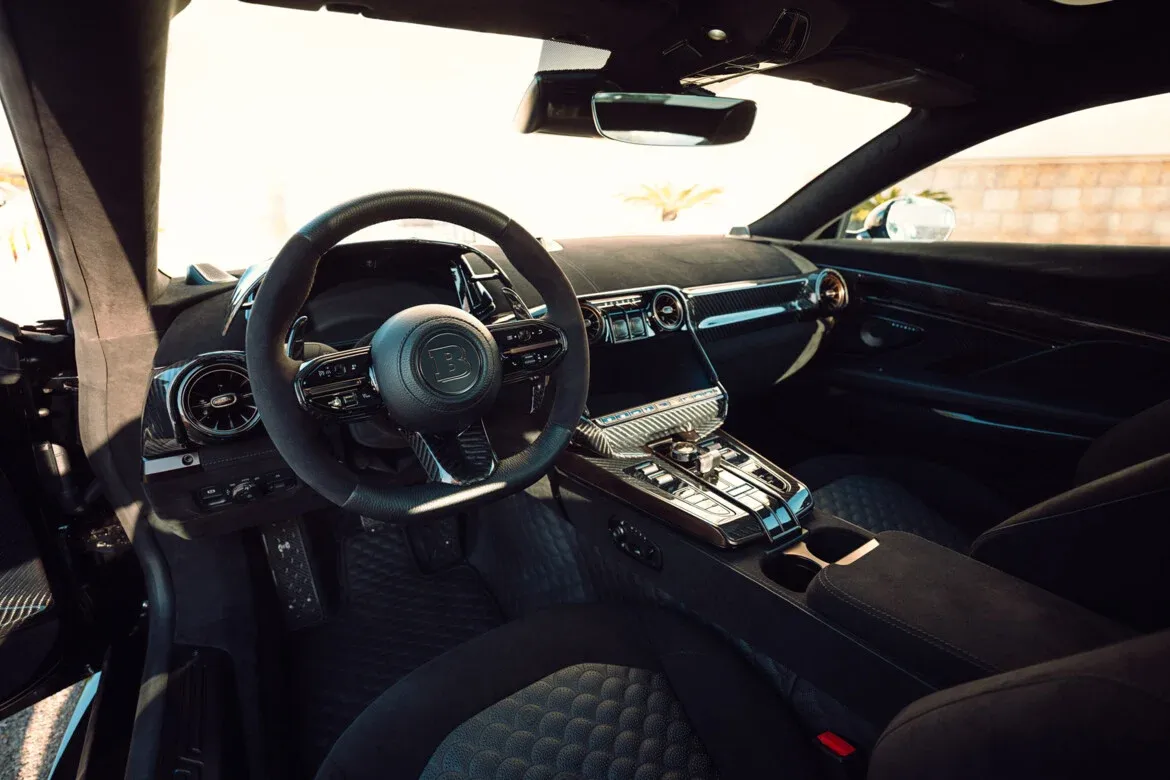
In the in-house BRABUS upholstery workshop, the Masterpiece interior of the BRABUS BODO was designed with a clear focus on combining long-distance comfort, precise driver control and unmistakable craftsmanship. In keeping with the “Piano Black” exterior finish, the cabin is trimmed in smooth black leather and contrasting black Nubuck leather, underscored by a selection of carbon-fiber elements on the steering wheel, dashboard, center console and door panels. High-gloss BRABUS “Shadow Gray” accents on selected interior components further emphasize the technical and contemporary character of the cockpit.
Occupants of the Gran Turismo coupe are welcomed by stainless-steel BRABUS entry panels and the embroidered signature of the vehicle’s namesake integrated into the door panels. The ergonomically contoured seats are designed to provide both exceptional comfort and strong lateral support during dynamic driving. Smooth leather is used throughout the seat surfaces, side bolsters and the integrated headrests, while Nubuck leather sections on the center console and integrated armrests in the door panels enhance grip and stability for driver and passenger. The dynamic silhouette of the BRABUS BODO is additionally embroidered into the seat backrests as a bespoke design detail.
The two rear seats continue the same material concept, featuring full leather upholstery and the signature BRABUS “Shell” quilting design found throughout the cabin. The precise stitching pattern is complemented by centrally embossed “Double-B” logos and BRABUS Masterpiece plaques. This quilting also extends to the leather-trimmed cockpit floor, luggage compartment, floor mats and trunk liner, creating a consistent visual identity throughout the interior. The ergonomically styled flat-bottom steering wheel likewise combines leather and Nubuck leather sections for optimal grip during rapid steering inputs. Additional sporty details include carbon-fiber pedals and a matching footrest.
To complete the ownership experience, each BRABUS BODO is delivered with a selection of bespoke accessories. The vehicle keys are wrapped in matching leather, while a leather BRABUS “Weekender” bag, likewise finished in the interior color of the Gran Turismo coupe, provides the ideal companion for extended journeys and weekend escapes. In addition, every vehicle is equipped with a blockchain-based Digital Product Passport integrated directly into a dedicated Spec Plate located in the luggage compartment. Developed in collaboration with the Aura Blockchain Consortium, the system provides verified documentation of authenticity, ownership and vehicle specification—ensuring complete transparency and traceability for every BRABUS Masterpiece produced in Bottrop, Germany.
Occupants of the Gran Turismo coupe are welcomed by stainless-steel BRABUS entry panels and the embroidered signature of the vehicle’s namesake integrated into the door panels. The ergonomically contoured seats are designed to provide both exceptional comfort and strong lateral support during dynamic driving. Smooth leather is used throughout the seat surfaces, side bolsters and the integrated headrests, while Nubuck leather sections on the center console and integrated armrests in the door panels enhance grip and stability for driver and passenger. The dynamic silhouette of the BRABUS BODO is additionally embroidered into the seat backrests as a bespoke design detail.
The two rear seats continue the same material concept, featuring full leather upholstery and the signature BRABUS “Shell” quilting design found throughout the cabin. The precise stitching pattern is complemented by centrally embossed “Double-B” logos and BRABUS Masterpiece plaques. This quilting also extends to the leather-trimmed cockpit floor, luggage compartment, floor mats and trunk liner, creating a consistent visual identity throughout the interior. The ergonomically styled flat-bottom steering wheel likewise combines leather and Nubuck leather sections for optimal grip during rapid steering inputs. Additional sporty details include carbon-fiber pedals and a matching footrest.
To complete the ownership experience, each BRABUS BODO is delivered with a selection of bespoke accessories. The vehicle keys are wrapped in matching leather, while a leather BRABUS “Weekender” bag, likewise finished in the interior color of the Gran Turismo coupe, provides the ideal companion for extended journeys and weekend escapes. In addition, every vehicle is equipped with a blockchain-based Digital Product Passport integrated directly into a dedicated Spec Plate located in the luggage compartment. Developed in collaboration with the Aura Blockchain Consortium, the system provides verified documentation of authenticity, ownership and vehicle specification—ensuring complete transparency and traceability for every BRABUS Masterpiece produced in Bottrop, Germany.
1 / 4
Equipment Highlights
Technical Data
| Power | 735 kW / 999 hp |
| Torque | 1200 Nm |
| 0-100 km/h | 3 s |
| 0-60 mph | 3 s |
| Vmax | 360 km/h / 223 mph |
Notices * All stated performance figures are approximate values. They depend on vehicle-specific details such as vehicle type, equipment, unladen weight, rear axle ratio, wheel/tyre combination, transmission design and aerodynamic equipment of the individual vehicle. Data on performance upgrades and/or performance kits are to be understood as average values. Test-related deviations of +/- 5% are possible. Information on the overall performance of factory engines modified by performance upgrades and/or performance kits is based on the manufacturer's specifications in the vehicle registration document, which in turn may deviate by +/- 5%. BRABUS accepts no liability for any further reductions in the performance of factory engines. Subject to technical modifications. The specified values were determined in accordance with the prescribed measuring procedure (Directive 80/1268/EEC in the currently valid version). The figures do not refer to an individual vehicle and do not form part of the offer, but are intended solely for the purpose of comparison between different vehicle types.
Efficiency & Fuel Economy
Fuel Economy* combined: 13.7 l/100km CO2: 312 g/km
A+
A
B
C
D
E
F
G
G
* Determined based on the measured CO2 emissions in consideration of the vehicle mass.